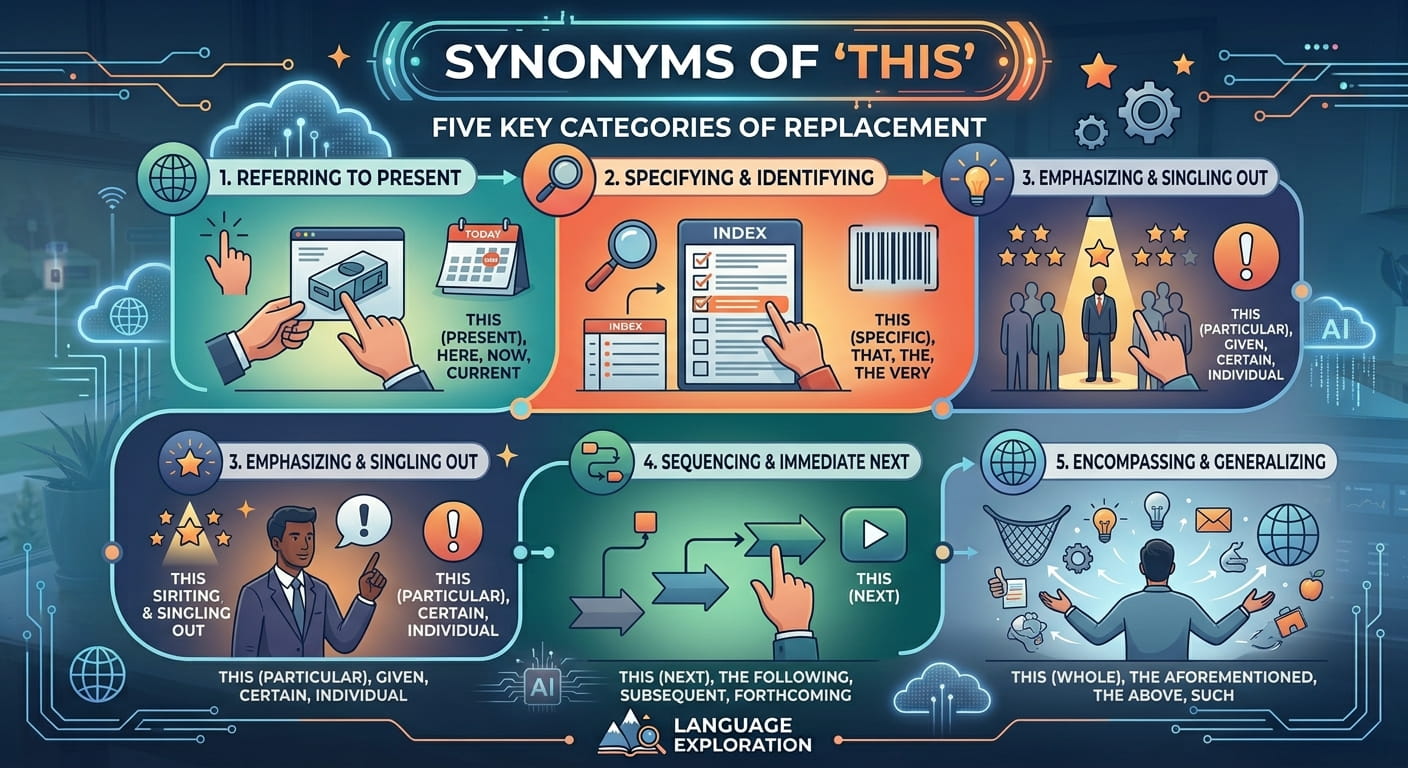
Synonyms of This: 100 Better Words to Use
If you want your writing to sound clearer, more varied, and more professional, the word “this” can quickly become repetitive. Overusing it makes sentences vague and weakens your message.
In this guide, you’ll find 100 natural alternatives to “this” that real writers use, including formal, casual, and precise options. Each word comes with a simple meaning and two examples, so you can use it in essays, blogs, emails, and everyday conversation.
Instead of repeating the same word again and again, use these replacements to say exactly what you mean.
Time and Place
Current
Meaning:
Happening now.
Examples:
The current plan looks good.
We must solve the current problem.
Present
Meaning:
Existing right now.
Examples:
The present situation is improving.
Enjoy the present moment.
Here
Meaning:
In this place.
Examples:
The answer is written here.
Please sit here.
Existing
Meaning:
Already in place.
Examples:
The existing rules still apply.
We improved the existing design.
Ongoing
Meaning:
Still continuing.
Examples:
The ongoing project needs support.
We discussed the ongoing issue.
Prevailing
Meaning:
Most common at this time.
Examples:
The prevailing opinion has changed.
The prevailing trend is remote work.
Contemporary
Meaning:
Belonging to the present time.
Examples:
Contemporary methods work faster.
She studies contemporary art.
Latest
Meaning:
Most recent.
Examples:
The latest update fixed the bug.
Read the latest report.
Recent
Meaning:
Happening a short time ago.
Examples:
The recent change improved results.
He mentioned a recent example.
Immediate
Meaning:
Happening right away.
Examples:
We need immediate action.
The immediate response helped.
Referring Back to Something
Aforementioned
Meaning:
Mentioned earlier.
Examples:
The aforementioned rule is important.
Follow the aforementioned steps.
Said
Meaning:
Already talked about.
Examples:
The said document is missing.
He agreed to the said plan.
Mentioned
Meaning:
Talked about before.
Examples:
The mentioned topic is interesting.
Review the mentioned point.
Noted
Meaning:
Written down or recognized.
Examples:
The noted problem needs attention.
The noted changes improved the design.
Given
Meaning:
Already stated or provided.
Examples:
The given answer is correct.
Use the given instructions.
Identified
Meaning:
Clearly recognized.
Examples:
The identified issue was fixed.
We solved the identified problem.
Specified
Meaning:
Clearly explained.
Examples:
Follow the specified steps.
Use the specified format.
Stated
Meaning:
Said clearly.
Examples:
The stated goal is realistic.
Meet the stated requirements.
Above
Meaning:
Written earlier in the text.
Examples:
The above point is key.
Check the above details.
Preceding
Meaning:
Coming just before.
Examples:
The preceding chapter explains it.
Read the preceding paragraph.
Previous
Meaning:
Coming before in time.
Examples:
The previous method was slower.
Refer to the previous email.
Earlier
Meaning:
Mentioned or done before.
Examples:
The earlier example shows it clearly.
Use the earlier version.
Referenced
Meaning:
Pointed to or mentioned.
Examples:
The referenced article is helpful.
See the referenced page.
Cited
Meaning:
Quoted or named as proof.
Examples:
The cited study is recent.
She checked the cited source.
Named
Meaning:
Called by a specific name.
Examples:
The named person will attend.
Contact the named manager.
Chosen or Selected
Highlighted
Meaning:
Marked as important.
Examples:
The highlighted text explains the rule.
Read the highlighted section first.
Listed
Meaning:
Written in a list.
Examples:
The listed items are on sale.
Choose from the listed options.
Selected
Meaning:
Chosen from many options.
Examples:
The selected design looks great.
Use the selected template.
Chosen
Meaning:
Picked or decided on.
Examples:
The chosen color is blue.
She liked the chosen style.
Picked
Meaning:
Chosen quickly.
Examples:
I picked the simple option.
He picked the best seat.
Preferred
Meaning:
Liked more than others.
Examples:
This is my preferred method.
She took her preferred seat.
Designated
Meaning:
Officially chosen for a purpose.
Examples:
Park in the designated area.
The designated leader spoke first.
Assigned
Meaning:
Given as a task or role.
Examples:
Finish the assigned work today.
He took the assigned seat.
Particular
Meaning:
One specific thing.
Examples:
This particular rule is strict.
I like that particular style.
Specific
Meaning:
Clearly defined.
Examples:
Give a specific example.
Follow the specific rule.
Certain
Meaning:
Known but not named.
Examples:
Certain rules still apply.
He avoided certain topics.
Connected and Matching
Relevant
Meaning:
Connected to the topic.
Examples:
The relevant facts are important.
Share relevant information only.
Related
Meaning:
Linked to the topic.
Examples:
The related article is helpful.
These are related ideas.
Similar
Meaning:
Almost the same.
Examples:
I found a similar example.
Their answers were similar.
Same
Meaning:
Exactly alike.
Examples:
We made the same choice.
They used the same idea.
Exact
Meaning:
Perfectly correct.
Examples:
That is the exact answer.
Use the exact words.
Precise
Meaning:
Clear and accurate.
Examples:
Give the precise time.
He explained the precise problem.
Corresponding
Meaning:
Matching something else.
Examples:
Check the corresponding chart.
Fill in the corresponding box.
Respective
Meaning:
Belonging to each one separately.
Examples:
They returned to their respective seats.
Each team led its respective project.
Applicable
Meaning:
Suitable for the situation.
Examples:
The applicable fee is small.
Follow the applicable rules.
Pertinent
Meaning:
Directly related to the matter.
Examples:
She raised a pertinent question.
Share only pertinent details.
Clear and Obvious
Direct
Meaning:
Clear and without confusion.
Examples:
He gave a direct reply.
The direct route is faster.
Clear
Meaning:
Easy to understand.
Examples:
The idea is clear.
She gave a clear answer.
Obvious
Meaning:
Easy to see.
Examples:
The mistake is obvious.
The answer was obvious.
Visible
Meaning:
Able to be seen.
Examples:
The change is visible.
The result is visible now.
Evident
Meaning:
Easy to notice.
Examples:
The problem was evident.
His effort was evident to all.
Apparent
Meaning:
Clearly seen or understood.
Examples:
The apparent cause was stress.
The benefit became apparent.
Plain
Meaning:
Simple and easy to see.
Examples:
The truth is plain.
The mistake was plain.
Straightforward
Meaning:
Simple and easy to follow.
Examples:
The instructions are straightforward.
Her answer was straightforward.
Clear-cut
Meaning:
Very easy to understand.
Examples:
The rule is clear-cut.
The answer was clear-cut.
Simple
Meaning:
Easy to understand.
Examples:
The simple rule is helpful.
Use a simple method.
Important and Useful
Notable
Meaning:
Worth attention.
Examples:
The notable change improved things.
That was a notable idea.
Important
Meaning:
Something that matters a lot.
Examples:
This is an important rule.
The important point is simple.
Useful
Meaning:
Helpful and practical.
Examples:
The tip is useful.
That guide is useful.
Helpful
Meaning:
Making things easier.
Examples:
Your advice was helpful.
The helpful guide saved time.
Practical
Meaning:
Useful in real life.
Examples:
The practical method works well.
Use practical solutions.
Effective
Meaning:
Working well.
Examples:
This is an effective idea.
The effective plan succeeded.
Strong
Meaning:
Powerful or reliable.
Examples:
He made a strong point.
That is a strong plan.
Solid
Meaning:
Reliable and good.
Examples:
This is a solid strategy.
She gave a solid answer.
Significant
Meaning:
Large or important enough to matter.
Examples:
The significant change surprised us.
It was a significant result.
Key
Meaning:
Most important.
Examples:
The key point is simple.
Focus on the key idea.
Trusted and Sensible
Reliable
Meaning:
Something you can trust.
Examples:
The method is reliable.
Use reliable sources.
Trusted
Meaning:
Believed in by people.
Examples:
Use trusted tools.
The brand is trusted.
Proven
Meaning:
Shown to work.
Examples:
This is a proven method.
Use proven strategies.
Valid
Meaning:
Correct or acceptable.
Examples:
Your point is valid.
The reason is valid.
Logical
Meaning:
Making sense.
Examples:
That is a logical step.
Her answer was logical.
Reasonable
Meaning:
Fair and sensible.
Examples:
That is a reasonable idea.
The price is reasonable.
Fair
Meaning:
Just and balanced.
Examples:
The rule is fair.
The decision was fair.
Balanced
Meaning:
Equal and stable.
Examples:
A balanced plan works best.
His opinion was balanced.
Sound
Meaning:
Based on good judgment.
Examples:
She gave sound advice.
It is a sound investment.
Credible
Meaning:
Believable and trustworthy.
Examples:
The credible report changed minds.
He is a credible witness.
Pronouns and Pointing Words
It
Meaning:
Refers to a thing already mentioned.
Examples:
I read the report and loved it.
It solved the problem.
That
Meaning:
Points to something mentioned or farther away.
Examples:
That idea works well.
I agree with that point.
These
Meaning:
Points to more than one thing nearby.
Examples:
These tips are useful.
These results look strong.
Those
Meaning:
Points to more than one thing farther away.
Examples:
Those steps are easy to follow.
Those examples helped me.
Such
Meaning:
Of the kind just mentioned.
Examples:
Such mistakes are common.
I have never seen such a plan.
One
Meaning:
Stands in for a thing already named.
Examples:
I like the blue one.
This method is better than the old one.
The same
Meaning:
Exactly the thing mentioned.
Examples:
Use the same method again.
We faced the same issue.
Latter
Meaning:
The second of two things mentioned.
Examples:
The latter option costs less.
I prefer the latter plan.
Former
Meaning:
The first of two things mentioned.
Examples:
The former choice is safer.
I chose the former idea.
Following
Meaning:
Coming next.
Examples:
Follow the following steps.
Consider the following points.
Formal and Special Use
Foregoing
Meaning:
Mentioned just before, in formal writing.
Examples:
Based on the foregoing reasons, we agree.
The foregoing rule applies.
Aforesaid
Meaning:
Said earlier, in legal or formal writing.
Examples:
The aforesaid terms remain valid.
Please read the aforesaid clause.
Above-mentioned
Meaning:
Named earlier in the text.
Examples:
The above-mentioned person called.
Check the above-mentioned file.
In question
Meaning:
The one being discussed.
Examples:
The file in question is missing.
The rule in question is outdated.
At hand
Meaning:
Being dealt with now.
Examples:
Focus on the task at hand.
The issue at hand is serious.
Concerned
Meaning:
Involved or affected.
Examples:
The concerned department will reply.
Inform the concerned person.
Underlying
Meaning:
Hidden but basic.
Examples:
The underlying cause is stress.
Fix the underlying problem.
Featured
Meaning:
Shown as a main item.
Examples:
The featured product sold out.
Read the featured article.
Attached
Meaning:
Joined to a message.
Examples:
Please open the attached file.
The attached form is required.
Enclosed
Meaning:
Included with a letter or package.
Examples:
See the enclosed document.
The enclosed card is for you.
Upcoming
Meaning:
About to happen.
Examples:
The upcoming event is free.
Prepare for the upcoming test.
Forthcoming
Meaning:
Coming soon, in formal writing.
Examples:
The forthcoming report will explain more.
Details will be in the forthcoming issue.
Instant
Meaning:
Happening very quickly.
Examples:
She gave an instant reply.
The fix was instant.
Core
Meaning:
Central and most basic.
Examples:
The core idea is simple.
Focus on the core issue.
Conclusion
Learning synonyms of “this” can greatly improve your writing and speaking. When you use different words instead of repeating “this,” your sentences become clearer, more precise, and more interesting.
Students can write stronger essays. Bloggers can create better content. And everyday English users can speak with more confidence.
Start practicing these words in your emails, essays, and daily conversations. The more you use them, the more natural they will feel.